How to Fix Receding Gums (and Why They Don’t Grow Back)
Receding gums do not grow back. Gum tissue does not regenerate the way a graze on your skin does, so once the margin has migrated down the tooth and left the root exposed, that tissue is gone for good. What you can realistically do is stop the recession getting worse, and — where it genuinely matters — have the root covered again surgically. Both of those work. Regrowth, in the sense the internet means it, does not.

Can receding gums grow back?
No. The gum that sits around your tooth is anchored to the root and the underlying bone by connective fibres, and when those fibres are lost the body does not lay them down again by itself. This is why every credible clinical option for recession either halts the process or moves tissue to cover the root. None of them regrow it where it stood.
That distinction matters more than it sounds. It changes what you should be spending your money and attention on: the cause, not a cure.
What the “natural regrowth” videos get wrong
Oil pulling, aloe vera gels, herbal rinses and mineral pastes are all promoted as ways to reverse recession. Some of them do reduce gum inflammation a little, and less inflammation is a real benefit. But an anti-inflammatory effect is not root coverage, and no rinse has been shown to move a gum margin back up a tooth.
There is a counter-intuitive twist worth knowing about. Inflamed gums are swollen gums, and swelling makes the margin sit slightly higher than the underlying attachment really is. When that inflammation settles — after a good clean, or after you finally start flossing properly — the swelling goes down and the recession can briefly look worse. It has not got worse. You are simply seeing the true position for the first time. Do not let that scare you back off treatment.
What causes receding gums?
Recession is usually the sum of a mechanical force and a biological vulnerability. Find which of these applies to you and you have found your treatment plan.
Brushing too hard, with the wrong brush
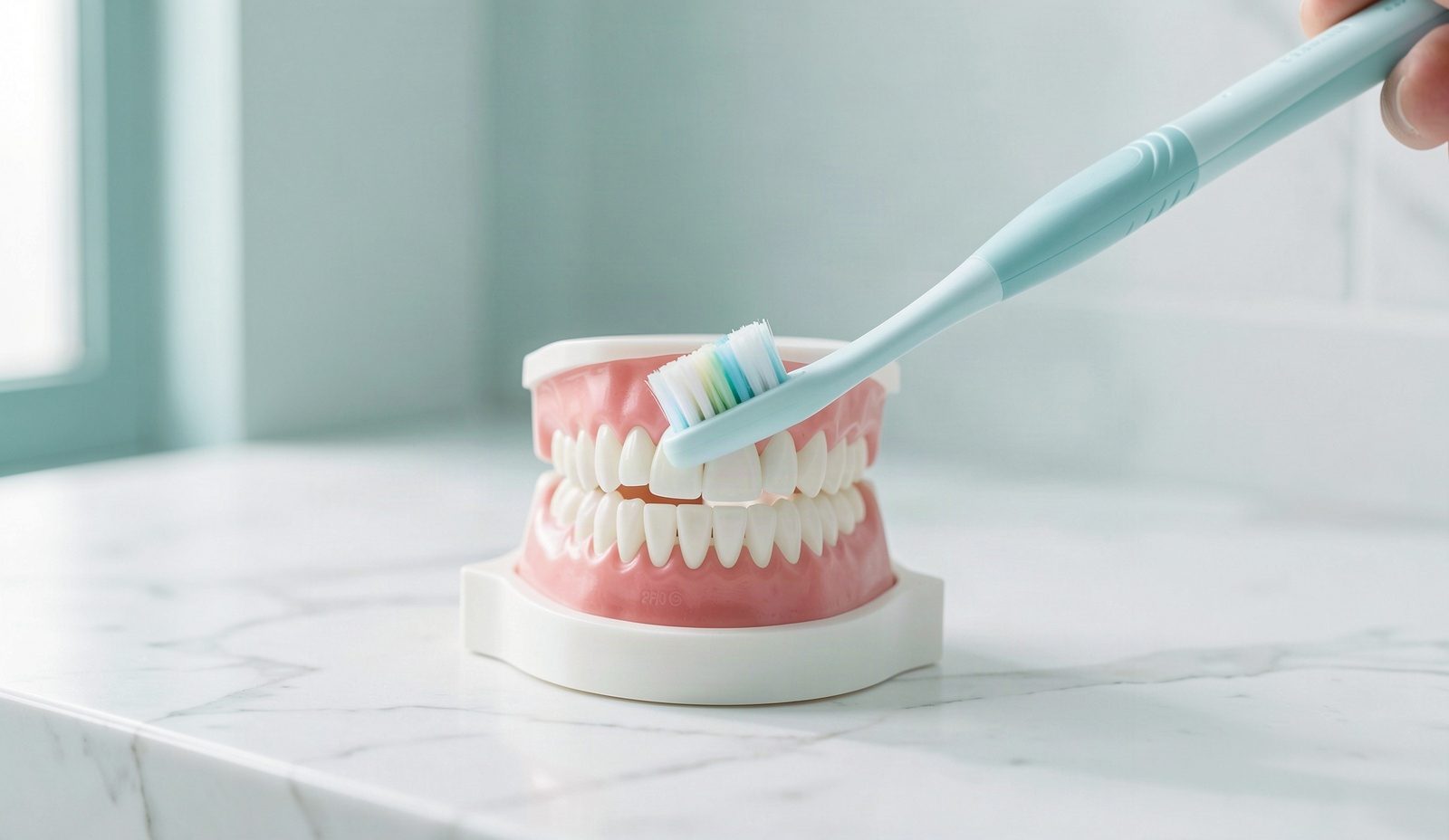
This is the most common cause in people whose gums are otherwise healthy, and the easiest to fix. Firm bristles and heavy horizontal scrubbing wear at the gum margin over years. A soft-bristled brush held at roughly 45 degrees to the gumline, moved in small circles rather than sawed side to side, removes plaque just as well without the abrasion. If you are unsure whether you are overdoing it, look at your brush after a month — splayed bristles mean too much pressure. Our guide to how often you should actually be brushing covers the technique in more detail.
Gum disease and long-running inflammation
Where recession comes from periodontal disease rather than abrasion, the tissue is being lost to inflammation and the bone underneath is often going with it. This is the more serious version, and it needs professional treatment rather than a change of toothbrush. Bleeding is the early warning sign — if your gums bleed when you clean between your teeth, read why gums bleed and hurt when you floss before you assume it is normal. Hormonal changes can amplify it too, which is why bleeding gums during pregnancy deserve their own attention.
Thin gums, genetics and grinding
Some people simply have thin gum tissue over prominent roots, and thin tissue recedes more readily under any given force. That is largely inherited — how much gum disease risk sits in your DNA is a genuine question with a partial answer. Tooth grinding and clenching add load, and orthodontic movement can push a root towards the outer plate of bone where the covering is thinnest.
Tissue thickness is not just a cause; it also predicts what happens after treatment. In a ten-year follow-up pooling six randomised trials, sites that ended up with at least 1.5 mm of keratinised tissue and 1.46 mm of gum thickness were the ones whose margins stayed stable over the following decade (Barootchi et al., 2022).
How to fix receding gums without surgery
Removing the cause is the actual treatment
For mild recession with no active disease, stopping the damage is the whole job, and it is more effective than it sounds — a margin that stops moving is a problem solved, even though nothing has been restored. In practice that means:
- Switching to a soft brush and a gentle, angled technique, or an electric brush with a pressure sensor.
- Cleaning between the teeth daily, since plaque left at the margin keeps the inflammation running.
- Professional scaling and root planing where there is periodontal disease, to clear bacteria from below the margin.
- A night guard if you grind, to take the load off the teeth.
- Monitoring: your dentist can chart recession depth so you know whether it is progressing or has settled.
Managing sensitivity on an exposed root
Exposed root surface has no enamel over it, so it reacts to cold and to brushing. A desensitising toothpaste, used consistently rather than occasionally, is the usual first step; a fluoride varnish applied at the surgery helps for more stubborn cases. Root surface also decays more easily than enamel, so the exposed area needs cleaning carefully rather than avoiding — sore spots often go under-brushed, which is exactly how root cavities start.
What gum surgery for receding gums actually achieves
Connective tissue grafting: the gold standard
Where the recession is deep, sensitive or visible when you smile, a periodontist can cover the root by moving tissue over it. The best-supported version takes a thin layer of connective tissue, usually from the palate, and places it under a flap drawn up over the root — a subepithelial connective tissue graft with a coronally advanced flap.
The evidence here is unusually consistent. A network meta-analysis of 38 randomised trials covering 830 patients and 1,265 recession defects ranked this combination first for root coverage and for gain of keratinised tissue, and its authors call it the gold standard for a single recession defect (Chambrone et al., 2022). An updated Cochrane review of 48 randomised trials reached the same conclusion, finding grafting superior to guided tissue regeneration with resorbable membranes (Chambrone et al., 2019). Donor-tissue substitutes such as acellular dermal matrix perform comparably for coverage, which is useful if you would rather not have a palatal donor site, though the graft retains an advantage for tissue thickness. Platelet-rich fibrin has been studied as an add-on, with modest and inconsistent benefit over grafting alone (Miron et al., 2020).
How long does root coverage last?
This is the part most articles leave out, and it is the part worth reading twice. Coverage is not necessarily permanent. When one randomised trial recalled its patients twelve years after surgery, the gingival margin had relapsed significantly in both treatment groups compared with the six-month result (Tavelli et al., 2019). The surgery had worked; it had partly undone itself over a decade.
That is not an argument against having it done. It is an argument for being clear-eyed about what you are buying, and for taking the thickness findings above seriously — the sites that hold up are the thicker ones, and the causes that produced the recession in the first place will happily produce it again if nothing else changes. Surgery without a change in brushing technique is a temporary purchase.
When should you see a dentist about receding gums?
Book an appointment if the gum margin is visibly moving, if teeth are becoming sensitive or look longer than they used to, if your gums bleed regularly, or if a tooth feels loose. Loose teeth and bleeding suggest the periodontal version of recession rather than the mechanical one, and that is time-sensitive — bone lost is not recoverable either.
Recession that has been stable for years and does not bother you may need nothing more than good technique and monitoring. Only a clinician who can measure it can tell you which of those you have, so if anything here describes your mouth, get it looked at rather than self-treating from a search result.
References
- Chambrone L, Botelho J, Machado V, Mascarenhas P, Mendes JJ, Avila-Ortiz G. (2022). Does the subepithelial connective tissue graft in conjunction with a coronally advanced flap remain as the gold standard therapy for the treatment of single gingival recession defects? A systematic review and network meta-analysis. Journal of Periodontology. https://doi.org/10.1002/JPER.22-0167
- Chambrone L, Ortega MAS, Sukekava F, Rotundo R, Kalemaj Z, Buti J, Pini Prato GP. (2019). Root coverage procedures for treating single and multiple recession-type defects: An updated Cochrane systematic review. Journal of Periodontology. https://doi.org/10.1002/jper.19-0079
- Barootchi S, Tavelli L, Di Gianfilippo R, Shedden K, Oh TJ, Rasperini G, Neiva R, Giannobile WV, Wang HL. (2022). Soft tissue phenotype modification predicts gingival margin long-term (10-year) stability: Longitudinal analysis of six randomized clinical trials. Journal of Clinical Periodontology. https://doi.org/10.1111/jcpe.13641
- Tavelli L, Barootchi S, Di Gianfilippo R, Modarressi M, Cairo F, Rasperini G, Wang HL. (2019). Acellular dermal matrix and coronally advanced flap or tunnel technique in the treatment of multiple adjacent gingival recessions. A 12-year follow-up from a randomized clinical trial. Journal of Clinical Periodontology. https://doi.org/10.1111/jcpe.13163
- Miron RJ, Moraschini V, Del Fabbro M, Piattelli A, Fujioka-Kobayashi M, Zhang Y, et al. (2020). Use of platelet-rich fibrin for the treatment of gingival recessions: a systematic review and meta-analysis. Clinical Oral Investigations. https://doi.org/10.1007/s00784-020-03400-7

BDS (Spain) | Registered & Practicing in Ireland
Practicing since 2018