Miswak: The Natural Toothbrush Stick (Ireland Guide)
Miswak is a real natural toothbrush stick, not a folk remedy with nothing behind it — several systematic reviews find it controls plaque about as well as a standard toothbrush, and may do slightly better against gum bleeding. The honest caveat, and the bit most online guides skip, is what it is best used for: the evidence supports it as a strong addition alongside a toothbrush, not a wholesale replacement for one.
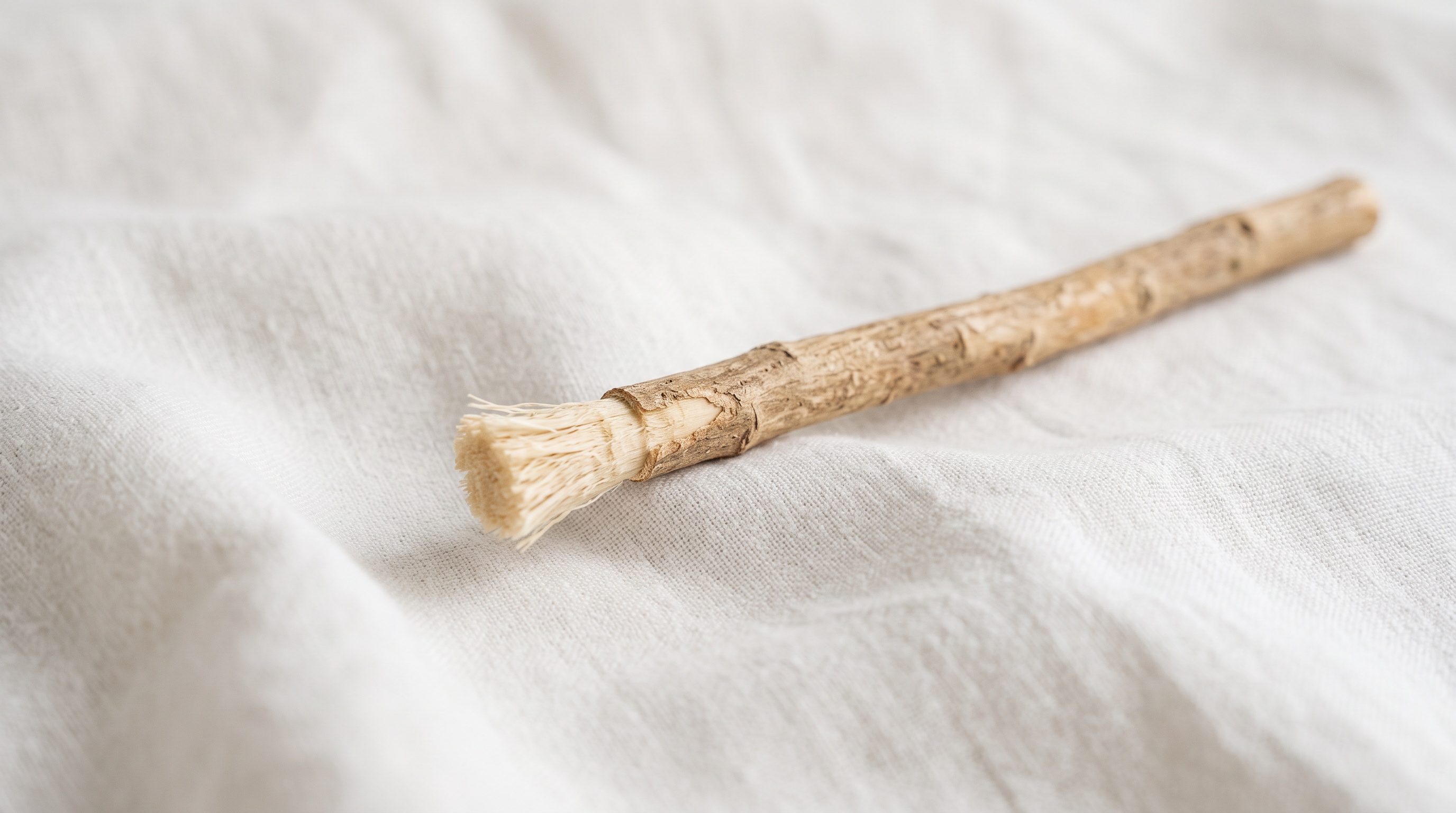
What is miswak, the natural toothbrush stick?
Miswak is a chewing stick cut from the root or twig of Salvadora persica, used for oral hygiene across the Middle East, Africa and South Asia for centuries, long before the nylon-bristled toothbrush existed — and long before it started showing up in health-food shops here in Ireland. One end is chewed and frayed until it splits into soft, bristle-like fibres, which are then used to brush directly against the teeth and gums. It has been studied in ten different forms — chewing stick, mouthwash, toothpaste, extract and more — and every reviewed form has reported some antibacterial, antiplaque or anti-gingivitis effect (Nordin et al., 2020). That breadth of positive findings is exactly why it is worth taking seriously rather than dismissing as tradition alone.
What the clinical trials actually show
Plaque and bacteria reduction
A meta-analysis of eighteen trials found miswak mouthrinse produced a strong antiplaque effect against placebo (mean difference 0.46, p < 0.00001), with a clear drop in the bacteria most linked to cavities — Streptococcus (mean difference −1.42) and Lactobacillus (−1.12) counts both fell significantly. Against chlorhexidine, the current gold-standard antiseptic rinse, miswak was measurably weaker (mean difference 0.19, p = 0.04) — better than nothing, not better than the strongest option available (Jassoma et al., 2019).
That trial used miswak as a rinse, not the chewing stick itself. For the stick directly against a toothbrush, a separate meta-analysis of five trials found plaque scores were statistically indistinguishable between the two (standardised mean difference −0.07, 95% CI −0.60 to 0.45) — genuinely comparable, not just “close enough” (Adam et al., 2021).
Gingivitis and bleeding gums
The same chewing-stick-versus-toothbrush meta-analysis found miswak ahead on gingivitis and bleeding specifically (standardised mean difference −2.07, 95% CI −4.05 to −0.10) — a wider, more confident margin than the plaque result (Adam et al., 2021). A second, independent meta-analysis of nine studies found the opposite nuance worth knowing: used on its own, miswak’s gingivitis benefit over a toothbrush was not statistically significant (p = 0.37). It only became clearly superior when added on top of normal brushing (p = 0.04) (Ramli et al., 2022). Two reviews, two slightly different pictures — which is itself the honest state of this evidence rather than a contradiction to paper over.
How miswak compares to a standard toothbrush
Why it works better alongside one, not instead
Put the two meta-analyses together and the pattern is consistent: miswak used by itself lands somewhere around “as good as a toothbrush” for plaque, with a real but inconsistently sized edge on gum bleeding. Used alongside a toothbrush, the combined effect on both plaque and gingivitis was significantly better than either alone (Ramli et al., 2022). That is the strongest, most reproducible finding in this literature, and it is also the most practical one — miswak as an addition to your normal brushing, not a swap for it, particularly since a chewing stick carries no fluoride and gives you none of fluoride’s cavity protection.
There is also a mechanistic reason the combination outperforms either on its own. A phytochemical analysis of the root bark found it rich in chlorides, sulfur compounds, silica, fluoride and alkaloids such as trimethylamine — chemistry that inhibits oral bacteria directly and, in the same studies, stimulated salivary flow enough to raise plaque pH, a caries-prevention route that has nothing to do with mechanical scrubbing (Akhtar et al., 2011). A toothbrush’s soft nylon bristles do the opposite job well: a consistent, repeatable shape that reaches every surface evenly, including the back molars a hand-chewed stick struggles to angle into. One supplies chemistry and antimicrobial action, the other supplies consistent, even mechanical coverage — two different jobs, not the same job twice.

Why fluoride toothpaste still belongs in your routine
Nothing in the miswak evidence above is a reason to drop fluoride toothpaste, and Irish dental guidance, like international guidance, continues to treat it as the evidence-based default — the two are not competing for the same job. Fluoride toothpaste is backed by the largest, most rigorous evidence base in preventive dentistry: a Cochrane network meta-analysis pooling 81 studies found that standard-strength fluoride toothpaste (1,000–1,500 ppm) reduces caries increment compared with non-fluoride toothpaste across every age group studied — a mean difference of −0.53 in decayed/missing/filled surfaces in adults (2,162 participants across three trials, moderate-certainty evidence), and a larger reduction of −1.86 surfaces in baby teeth with 1,500 ppm fluoride. Higher concentrations gave a further, smaller reduction on top of that, with the benefit levelling off at higher ranges (Walsh et al., 2019).
That matters here because fluoride’s protection works through a completely different mechanism to anything a natural toothbrush stick or an ordinary toothbrush provides mechanically. Fluoride is taken up into the enamel surface and converts it into fluorapatite, a more acid-resistant mineral, which helps enamel resist and even partly reverse the earliest stages of decay. Removing plaque — which is what both a toothbrush and miswak do, one mechanically and one with some added antibacterial chemistry — reduces the bacterial acid attack in the first place, but it does not strengthen the enamel itself the way fluoride does. The two protections are additive, not interchangeable, which is exactly why switching which tool you use to brush should never mean dropping fluoride toothpaste from the routine.
How to use a miswak stick correctly
Technique matters more with this natural toothbrush stick than with an ordinary toothbrush, because an unprepared stick genuinely is just a twig. The preparation step is what turns it into something that functions like a brush at all, and most of the disappointment people report with miswak traces back to skipping it.
Preparing the stick
- Buy fresh sticks rather than ones that have dried out in packaging for months — a dry stick frays poorly and tastes bitter; fresher ones soften faster and have more of the active plant chemistry intact.
- Cut or peel away about a centimetre of bark from one end with a clean knife, exposing the fibrous wood underneath.
- Chew that exposed end gently for a minute or two, turning it as you go, until it splits into soft, brush-like fibres. Do not brush with it before it has properly frayed — unfrayed wood is what causes gum nicks, not the plant itself.
- If the stick feels dry or stiff, soak the tip in a little water for a few minutes first; it should fray easily once softened.
Brushing technique
- Hold it like a pencil and brush at a gentle angle against the gumline in short strokes, the same way you would with a soft-bristled brush — not hard back-and-forth scrubbing.
- Work the outer and inner surfaces of both arches, giving a little more time to the front teeth, which is where a hand-held stick reaches most reliably; a toothbrush is still the more dependable tool for the back molars.
- Traditionally the frayed end is also drawn lightly over the tongue, which is a reasonable addition but not a substitute for anything else in your routine.
Fitting it into your routine, and keeping it hygienic
- Keep brushing twice daily with a fluoride toothpaste and toothbrush as the base of your routine; use this natural toothbrush stick as an extra session — after a meal, or whenever you would otherwise skip cleaning your teeth.
- Trim off the used, frayed section and re-expose fresh wood every day or two by cutting a little further up the same stick; discard it entirely once it stops fraying cleanly or starts to smell sour.
- Rinse it after use and store it upright somewhere it can air-dry — the fibres are porous and hold bacteria if left damp, the same hygiene issue as any natural-bristle brush.
- Treat it as personal, like any toothbrush — do not share a stick between household members.
Who should be cautious with miswak
A natural toothbrush stick that hasn’t been frayed is effectively a piece of raw wood against soft tissue, and can nick the gums if you skip the chewing step. Because it carries no fluoride, relying on it alone leaves you without fluoride’s specific protection against cavities, so it suits people already managing decay risk through toothpaste or fluoridated water, not as their only defence. If you already have gum recession or notice ongoing bleeding, that is a sign to see a dentist rather than brush harder with anything, stick or toothbrush alike.
If you are weighing up natural options generally, our guide to what natural toothpaste actually means covers the same evidence-first ground for the other half of brushing, our look at what actually makes a toothbrush effective explains why technique and bristle softness matter more than the material in your hand, and why fluoride is in your toothpaste in the first place fills in the rest of the picture above. Whatever you brush with, the usual signs that it is time to replace it still apply.
References
- Jassoma E, Baeesa L, Sabbagh H. (2019). The antiplaque/anticariogenic efficacy of Salvadora persica (Miswak) mouthrinse in comparison to that of chlorhexidine: a systematic review and meta-analysis. BMC Oral Health. https://doi.org/10.1186/s12903-019-0741-5
- Adam FA, Mohd N, Rani H, Baharin B, Mohd Yusof MYP. (2021). Salvadora persica L. chewing stick and standard toothbrush as anti-plaque and anti-gingivitis tool: A systematic review and meta-analysis. Journal of Ethnopharmacology. https://doi.org/10.1016/j.jep.2021.113882
- Ramli H, Nor Aripin KN, Mohd Said S, Mohamad Hanafiah R, Mohd Dom TN. (2022). The effectiveness of miswak (Salvadora persica L. and Azadirachta indica A.Juss.) practices in reducing plaque and gingivitis among adults: A systematic review and meta-analysis. Journal of Ethnopharmacology. https://doi.org/10.1016/j.jep.2022.115598
- Nordin A, Bin Saim A, Ramli R, Abdul Hamid A, Mohd Nasri NW, Bt Hj Idrus R. (2020). Miswak and oral health: An evidence-based review. Saudi Journal of Biological Sciences. https://doi.org/10.1016/j.sjbs.2020.05.020
- Akhtar MS, Siddique T, Bi S, Mujeeb M. (2011). A review on phytochemical and pharmacological investigations of miswak (Salvadora persica Linn). Journal of Pharmacy and Bioallied Sciences. https://doi.org/10.4103/0975-7406.76488
- Walsh T, Worthington HV, Glenny AM, Marinho VC, Jeroncic A. (2019). Fluoride toothpastes of different concentrations for preventing dental caries. Cochrane Database of Systematic Reviews. https://doi.org/10.1002/14651858.cd007868.pub3
